
| PROS | CONS |
|---|---|
| + Responsive + Excellent rocker + Versatile + Improved fit | – None |
It’s been two years since Topo Athletic released the first edition of the Atmos in late 2023. Nothing was wrong with the first one; in fact, it was one of my favorites that year. Instead, Topo made the decision to adopt a bi-annual shoe release schedule — uh, that is, releasing updates every other year — not twice a year. (Could you imagine how batshit that’d be?) And not every year like most companies do. I think we can agree no shoe actually needs an annual update: it’s a money grab, designed to profit off a minor adjustment. So, did the second edition of Topo’s max cushioned pair meet my lofty expectations after an exceptional debut? Find out, in this Topo Athletic Atmos 2 review.
Intro
Founded in 2013 by Tony Post of Vibram Fivefingers fame, Topo is a unique player in the running shoe game. Topo designs shoes with lower drops (5 mm is their largest), a narrow and secure midfoot and heel, and wider toebox design. Topo believes these features help the feet move more naturally.
Historically, Topo has, perhaps, been better known for their expansive trail shoe lineup. But well-received hits like the Pebax-powered Specter and Cyclone, and most recently, the Atmos, position Topo as a rising star on the roads, too.
Topo compares the Atmos to max cushion shoes including the HOKA Bondi, Saucony Triumph, ASICS Gel-Nimbus, Brooks Glycerin, and New Balance Fresh Foam 1080. While that may seem like a stretch to the uninitiated, I’m here to say the Atmos is actually better than some of these pairs.
Topo Athletic Atmos 2 Review
| STACK HEIGHT | WEIGHT | PRICE |
|---|---|---|
| 40/35 mm (5 mm drop) | M9: 9.9 oz/281 g W7: 8 oz/227 g | $165 ($5 increase) |
Midsole
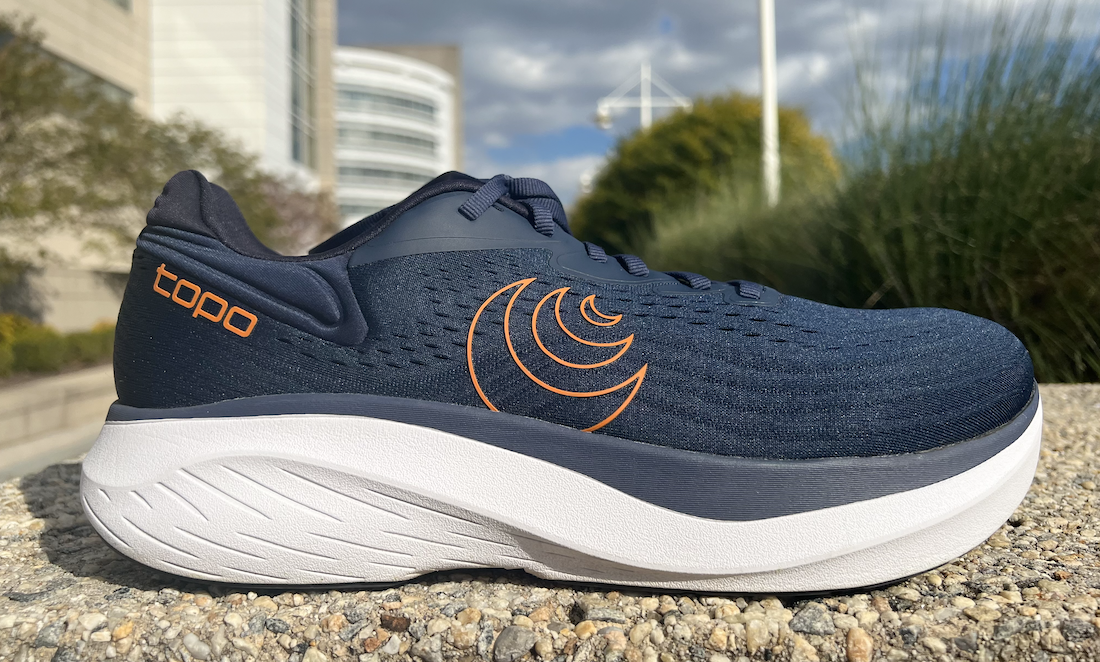
Topo introduces an upgraded version of Zipfoam, adding 2 millimeters to both the heel and forefoot, increasing from 38 mm/33 mm to now a 40 mm/35 mm stack height.
Interestingly, Topo is one of the only brands I’ve seen that breaks down each component of the stack height. Not that you asked, but here’s what comprises the 40/35 mm measurement:
- Midsole: 31.5 mm (heel)/27.5 mm (forefoot)
- Rubber outsole: 3.5 mm/2.5 mm
- Footbed: 5 mm
Zipfoam is made of an EVA-blend that incorporates thermal plastic material to make it bouncier and 25% more durable than traditional EVA, according to Topo. This foam provides excellent energy return, even more so than in v1. It has a similar feel to Brooks’ nitrogen-injected EVA-based DNA Loft v3 foam, but it’s more firm.
There are Ortholite™ performance insoles for added comfort and support.
Ride
The Atmos 2 has one of the best rocker geometries out there, in my not-so-humble opinion. A lot of shoes have a rocker these days, but this one provides some of the most effortless, natural heel-to-toe transitions as a heel-striker. It’s not a ride you have to think much about. Just set tie it and forget it! Seriously, this is one of the most efficient max cushioned running shoes. No wasted energy.
Zipfoam is quite responsive and I can really feel the difference between this and traditional EVA foams. The Atmos 2 provides an excellent example of how EVA foam can “pack a punch” when infused with other materials. Because, Lord knows, regular EVA is as mundane as the missionary position.
Underfoot landings lean more on the “firm” end of the scale, but it’s not too firm a ride. And this is coming from someone who typically prefers the softest of soft shoes.
The ride is quite stable for a neutral shoe, due to sidewalls and a sole flare. The Atmos 2 can easily serve as a stable-neutral option for those who need some support.
The Atmos 2’s solid sub-10-ounce weight (9.9 oz) for a men’s size 9 makes me feel quick on my feet, and it’s a noticeably lighter running experience compared to other max cushion shoes that typically range from 10-11 oz. It sure helps with tired legs!
It’s a very versatile pair that can tackle daily training, recovery day, and even long runs. I did a couple 10-mile general aerobic runs (15-25% slower than marathon pace or 65-78% of max heart rate) right out of the box and felt like I could’ve kept going strong.
Although not a shoe I’d ever do speed workouts in, the combo of the foam and rocker geometry make it rather easy to accelerate in. The Atmos 2 just makes me want to push the pace — sometimes faster than I should in training.
While Topo compares the Atmos to the Brooks Glycerin, it reminds me more of the Brooks Ghost Max 3 — a considerably lighter (more than an ounce) and more energetic Ghost Max 3. They’ve got a near identical stack height and drop (Ghost Max is 39/33 mm) and similar-feeling foams with rides boosted by excellent rocker geometry. The Ghost Max feels softer than the Atmos underfoot.
Upper
My one gripe about the Atmos v1 was the shorter tongue that sat too low on the top of my foot. Topo doesn’t mention an updated tongue, but this one feels larger, and more substantial, greatly improving step-in comfort and ensuring a better foot lockdown. The padding in the heel counter helps provide additional support.
The breathability of the engineered mesh upper remains from v1, with ample ventilation holes. And, as with all Topo shoes, the Atmos 2 has a roomy anatomical toe box to allow the toes to spread naturally. Overall, it’s a much more comfortable experience than v1.
Outsole
Topo notes v2 of the Atmos gets a new outsole design with strategic rubber zones to enhance flexibility and increase traction. The first version already was a very durable, grippy shoe that goes the distance. No durability concerns whatsoever after 50+ miles.
The broad outsole base and sole flare (the sole extends outward beyond the upper) help contribute to the stable ride.
Weight
The second edition gained an insignificant 0.2 ounces from v1. It’s still a great weight for a max cushioned pair, coming in just under 10 ounces for a men’s size 9 (9.9 oz/281 grams) and 8 ounces/227 grams for a women’s size 7. As expected, the shoe didn’t feel any heavier.
The minor weight gain likely stems from the small addition in foam and updated upper.
Aesthetics
In the product sheet, Topo notes the upper has “added visual interest” compared to v1. I’ll be honest, I have no idea what they mean by this. The shoe looks almost identical to the first edition. The one small change I noticed in the navy blue colorway is the Topo logo changing from black to orange on the side of the shoe, and the addition of the orange logo to the tongue. Oh, and “Topo” on the heel is now orange instead of black. So basically, it’s just “added visual branding.” But the color accents actually do make the shoe look much better.
Colors aside, the Atmos 2 is a decent-looking shoe, even if the wider toe box design gets docked some imaginary points by the ultimate imaginary authority on shoe fashion.
Price
At $165, the Atmos 2 increased $5 in price from v1. It’s certainly not a deal-breaker, and it’s right in line with most max cushioned trainers, but I’d have loved to see it keep the more friendly $160 price point. However, the shoe did add an upgraded midsole, new outsole, and a bit more foam that makes the price increase logical.
Conclusion
No “sophomore slump” here. With an upgraded midsole foam and new outsole, Topo elevates an already stellar shoe. One of the most versatile pairs around, the Atmos 2 is easily on par with — and in many cases, better than — many max cushioned shoes in its price range.
If you’re looking to try Topo for the first time, the Atmos 2 is the perfect pair to start with.
The Atmos 2 is available on Topo’s website.
Topo graciously provided this shoe to me for wear testing. I was not compensated for this Topo Athletic Atmos 2 review and they didn’t get an opportunity to see this Topo Athletic Atmos 2 review before I published.
- Dos Equis Introduces the “Most Interesting Runner in the World”
- ASICS: “Not Just Running Shoes—We Also Sell Pickleball Crap”
- FanDuel Lets You Bet on Amateur Runners—Even Your Daughter
- Saucony Partners with Duolingo to Educate Runners on ‘Saucony’ Pronunciation
- Archaeologists Unearth Prehistoric Running Shoe Circa 2019
- Goldendoodle “Winston” Burned Out from Marathon Training
- Healed Injury Refuses to Quit Being Mitch’s Excuse Not to Run
- Company Confuses ‘Biannual,’ Locks Itself Into Double the Shoe Updates
- Report: “The Yips” Afflicting Runners at Alarming Rate