
| PROS | CONS |
|---|---|
| + Lighter + More versatile + Less stack = more stable + Solid energy return | – Pricey – Dense upper |
HOKA’s max cushioned neutral super trainer returns with a leaner update that streamlines the design. I detail my experience running in the pair through 40 miles, in this HOKA Skyward X 2 review.
HOKA Skyward X 2
| STACK | WEIGHT | PRICE |
|---|---|---|
| M: 46/41 mm W: 44/39 mm (5 mm drop) | M10: 11.0 oz/312 g W8: 9.3 oz/263 g | $225 |
It’s official: The HOKA Skyward X 2 has made history. It’s the first running shoe to actually subtract stack height in an update, instead of adding a couple millimeters…or 5. Fine, it’s not the first ever, but you’d have a much better chance finding a pull tab in a hay stack than wearing a circumcised updated pair. Because it’s 2026: every running brand and their parent company firmly believes less is not more. More is more. And every shoe must have more foam underfoot so they can disproportionately raise the price $10 each year. Yes, running shoe brands are why we can’t have nice things at nice prices.
Of course, the original Skyward X was one of the tallest-stacked shoes, so shedding a few millimeters doesn’t exactly change the shoe’s classification as a behemoth. Both the heel and forefoot stack are still in the 40+ mm range.
But ironically it’s HOKA, the originator of max cushion kicks who launched the beefy Bondi back in 2011 amid the barefoot running craze, that’s the company to knock their behemoth-sized Skyward X down a couple millimeters…or 5. Unfortunately, the high $225 price tag hasn’t decreased along with the stack. You’d have a much better chance finding a pull tab in a hay stack than a price decrease.
But the stack height isn’t all that’s changed. Naturally, the shoe is now a bit lighter, coming in at 11 oz (312 g) for US M10 and 9.3 oz (263 g) for US W8. These two modifications make the Skyward X much more versatile for different run types, and much easier to run in.
Ride
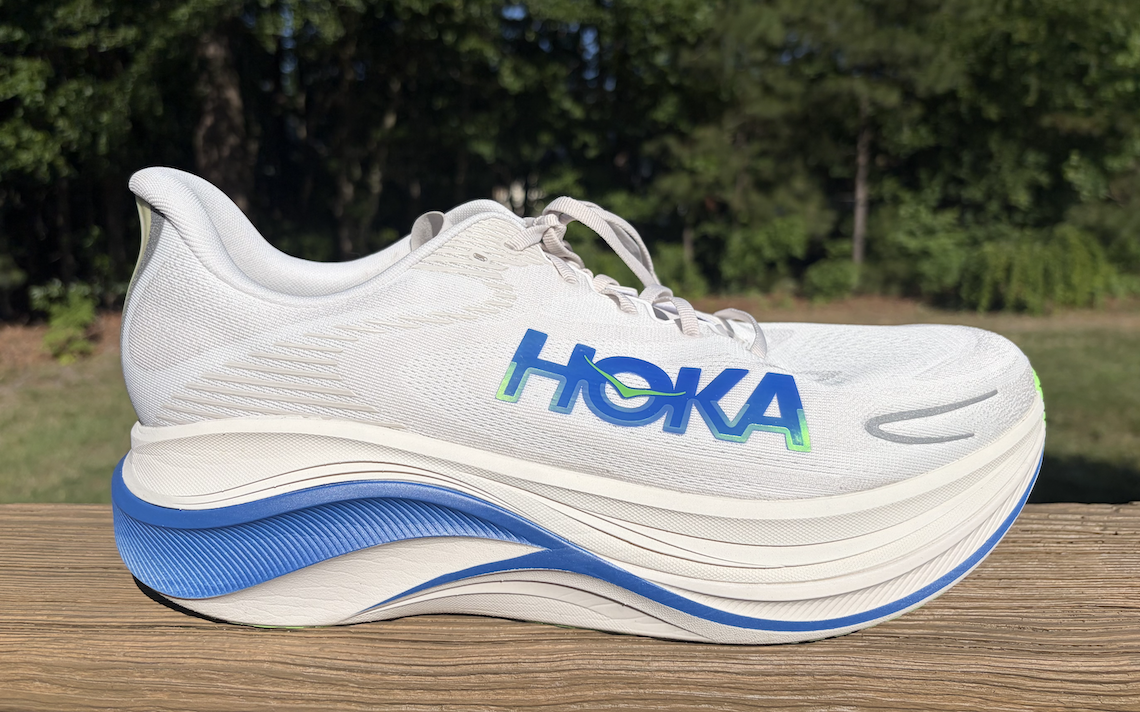
The dual-density midsole carries over from v1, with a redesigned convex carbon fiber plate sandwiched between the top layer of PEBA foam and bottom super critical EVA frame that provides a stable base. Speaking of, the shoe’s slightly lower stack, combined with its prominent sidewalls and a wide outsole base greatly improve the stability from v1 that felt like “too much shoe” at times. While not a true stability shoe, it’s quite a stable ride for a shoe with this much stack (46 mm/41 mm). The first edition of the Skyward X could be quite unstable, especially at faster paces, and doesn’t provide nearly as secure a ride as the X 2.
With a lighter weight and less stack, the shoe feels more responsive than v1. The lightweight PEBA foam makes for a slightly bouncy ride while the carbon plate works in tandem with the lively midsole for enhanced energy return. Underfoot, there’s a softer sensation that makes for more forgiving landings. HOKA doesn’t provide specific details about how they updated the carbon plate, but the ride feels more efficient this time around.
With the carbon plate and high stack, it’s a stiff shoe without much flexibility, but I find it’s still a smooth ride. There’s excellent early stage rocker geometry, which propels the foot into smooth heel-to-toe transitions that make it easy to cruise for mile after mile. I found I was able to keep a consistent pace without having to worry about checking my watch after each mile split.
Uses
On the whole, this is a more dynamic pair than its predecessor. Offering both a plush and stable ride for tired legs and an energetic ride when you want to pick up the pace a bit, the Skyward X 2 serves as a solid long run shoe, daily trainer, and easy day pair. Of course, despite the PEBA foam, carbon fiber plate and high price point, it’s not designed as a shoe to tackle speed workouts or race in, given its weight. Remember, this is a super trainer, not a super shoe designed for racing. And yes, the “super” label sure is super lame.
Many runners believe if you’re going to fork over $200+ for a pair of shoes, you should be able to race in it. And I tend to agree. Sadly, racing super shoes currently range from $240-$300.
Price
Spoiler: $225 is not a small amount of money. But as a max-stacked, carbon-plated super trainer with two foams (one being PEBA), it’s roughly in line with market prices, however egregious they are. Personally, I think it’s a better value and more versatile shoe than the $230 Nike Vomero Premium super trainer, which has a bonkers 55.5 mm/45.5 mm stack and no plate. The Vomero Premium, while fun, can feel a bit one-dimensional after a while.
Another consideration, because of the type of lightweight foam used and the carbon plate, HOKA notes this shoe should last around 200-300 miles, which is less than a typical daily trainer that can last around 500 miles.
Upper
I’ve experienced no discomfort in the creel jacquard upper, which has a zonally padded tongue and ample padding in the heel collar. It’s quite the comfy upper that runs true to size and it’s not difficult whatsoever to get a secure foot lockdown. Despite the lighter material, breathability is still not great with such a plush upper, but I’m never one to complain about a little foot sweat.
Maybe it’s just me, but the upper design is kind of “blah.” Like I said in my review of the original Skyward X, despite the innovation inside the shoe, the outside looks very outdated to me. I mean, it looks like a shoe Shaquille O’Neal and his size 20 feet would run in.
Conclusion
Less stack, lighter weight, and an updated carbon plate elevate the Skyward X 2 to new heights. Ironically it’s HOKA, of all shoe brands, who proves that, sometimes, less shoe is more.
The Skyward X 2 is now available on HOKA’s website.
HOKA graciously provided this shoe to me for wear testing. I was not compensated for this HOKA Skyward X 2 review and they didn’t get an opportunity to see this HOKA Skyward X 2 review before I published.