
| PROS | CONS |
|---|---|
| + Great price + More responsive + Softer ride + Not heavy | – None |
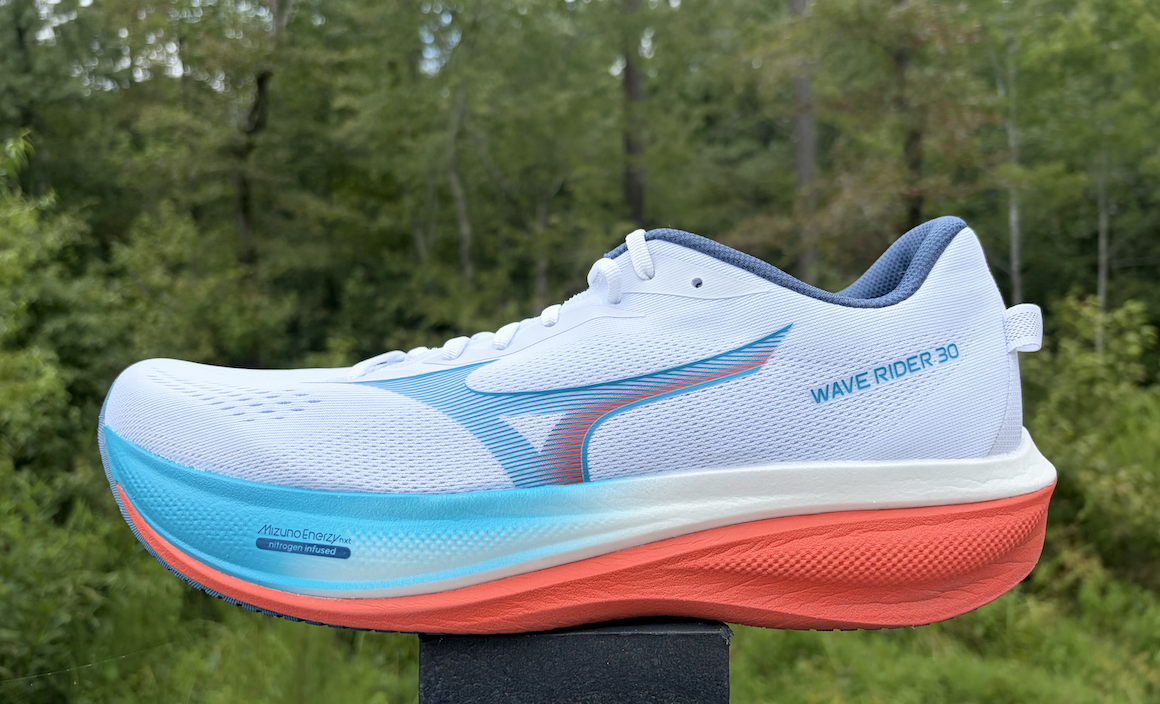
Making it to the 30th edition of a running shoe is no small feat. Hell, there are some movie franchises that last longer than running shoes. Fittingly, Mizuno decided to celebrate the momentous occasion with a totally revamped iteration of their flagship trainer. Does the update move the needle? I detail my experience running in the pair through 40 miles, in this Mizuno Wave Rider 30 review.
Mizuno Wave Rider 30
| STACK | WEIGHT | PRICE |
|---|---|---|
| 42.5/34.5 mm (8 mm drop) | M9: 9.4 oz/266 g W8: 8.1 oz/229 g | $150 |
Intro
It can be easy to forget the Wave Rider is a plated shoe. It can be even easier to simply not know the Wave Rider is a plated shoe.
But it’s true. The midsole has contained the Wave Plate since its inception in 1997. Does that make the Wave Rider the first-ever plated shoe? I’m certainly not going to do any research, so let’s just say it is. Crazy, right?!
Of course, the Wave Plate, made from Pebax Rnew, a sustainable, bio-based polymer derived from castor beans, not to be confused with cannellini beans, is certainly no carbon fiber plate. This is the Mizuno Wave Rider we’re talking about. It’s not exactly the most exciting shoe in Mizuno’s lineup–or any brand’s lineup. But version 30 is certainly an exciting update for the iconic pair.
Because much like Jennifer Garner’s character in the hit 2004 romcom, 13 Going on 30, the Mizuno Wave Rider is “thirty and flirty and thriving.” Ok, maybe not flirty, but it’s definitely thirty and thriving.
Updates
Mizuno did a big overhaul of the Wave Rider to commemorate its three decade run. For the first time, the Wave Plate now runs the full‑length of the shoe. But wait, there’s more!
There’s an additional 3.5 mm of foam in the heel and 5.5 mm in the forefoot, changing the previous 39/29 mm stack height to a heftier 42.5/34.5 mm. Now that’s what I call max cushioning! Think: Now That’s What I Call Music, but instead of shitty pop songs, it’s recorded sounds of max-stacked running shoe outsoles loudly thumping the pavement. Rock on!
As a result, the drop has dropped from 10 mm to a more standard 8 mm. Shit, I’m old enough to remember the Wave Rider having a despicable 12 mm drop. Although, I’m willing to bet anyone not currently going through puberty is old enough to recall the 12 mm drop, given it was just a couple years ago in the Wave Rider 28.
Ride
Right off the bat, I can tell this ain’t the Wave Rider of old. That’s right; this is the Wave Rider of new. First and foremost, there’s now a pleasantly soft underfoot sensation, much softer than any previous version of the traditionally firmer shoe. Don’t worry, it’s still the stable pair the Wave Rider has become known for over the years. The widening of the outsole base is just one reason why.
It’s also more responsive than previous versions, thanks to an updated version of the nitrogen-infused supercritical ENERZY NXT foam, made from EVA. The lighter, more resilient foam responds better to the extending of the now full-length Wave Plate. The plate adds some stability and improved rebound. Again, just don’t expect it to perform like a more expensive carbon fiber plated shoe.
The heel stack doesn’t feel nearly as tall as its 42.5 mm would suggest, in a good way. And while version 30 is technically a tenth of an ounce heavier than its predecessor, at 9.4 oz (266 g) for men’s size 9 and 8.1 oz (229 g) for women’s size 8, it’s still an excellent weight for a shoe of its nature.
It all adds up to a nimble pair that won’t bog you down like some heavier, clunkier Wave Riders of old. Remember, this is the Wave Rider of new!
While all 10 mm drop shoes work extremely well with my stride, the new 8 mm drop will be a welcome change for runners that prefer a more typical drop. Add in the shoe’s updated rocker geometry, and the ride is noticeably smoother compared to its predecessor.
Uses
I went for a 10-miler out of the box and immediately loved the ride. I ran faster miles than I had planned for (7:50/mile average) and that was a testament to how effortless it feels to run in this shoe, which makes it a great long run option in addition to an excellent daily trainer. In the past, I’d never reach for the Wave Rider for a long run because there were more exciting options available. And while there are still plenty of exciting competitors to lace up, when it comes to comfort, responsiveness, and durability, you can’t go wrong with this version of the Wave Rider. I’ll gladly take the pair for runs of up to 14 or 15 miles during marathon training.
And while its primary use is as a daily trainer, its softer, cushioned feel makes it a forgiving option for sore legs on recovery day.
Upper and Outsole
There’s a comfy redesigned jacquard mesh upper that has a stretchy, gusseted tongue and padding in the heel collar for a secure fit. It’s a roomier upper than the previous version, with enough room for my feet to breathe from heel to forefoot. The breathability is also greatly improved from the mesh upper in the 29.
As is typical for the Wave Rider, there’s a very durable X10 outsole made of carbon rubber. The decreased rubber coverage helps make the ride smoother without sacrificing longevity.
Price
You’ve got to credit Mizuno for not raising the price $10 like every running brand does when there’s even the slightest of an update. Despite adding a considerable amount of foam and extending the Wave Plate, the trainer still goes for a very reasonable (by today’s standards) $150. I swear, some companies raise the price $5 just for adding a heel pull tab. Speaking of, I buried the lede by not mentioning perhaps the greatest update: for the first time, there’s a pull tab on the heel! Rejoice, pull tab users! I don’t understand why you’d ever need assistance putting on and removing running shoes, but I’m sure glad you’re getting the help you so dearly need. I can’t even imagine how difficult the act of running is for you.
Conclusion
New Wave Rider, who dis? Forget everything you thought you knew about Mizuno’s flagship trainer. The Japanese brand marks the iconic pair’s 30th anniversary with more foam and more Wave Plate, without charging more money.
The Wave Rider 30 is now available on Mizuno’s website.
Mizuno graciously provided this shoe to me for wear testing. I was not compensated for this Mizuno Wave Rider 30 review and Mizuno didn’t get an opportunity to see this Mizuno Wave Rider 30 review before I published.
This review includes affiliate links, which means I may earn a small commission if you purchase using the links (at no extra cost to you.)