
| PROS | CONS |
|---|---|
| + Good price + Great weight + Versatile + Stable ride | – Narrow, tight-fitting upper – Can feel stiff initially |
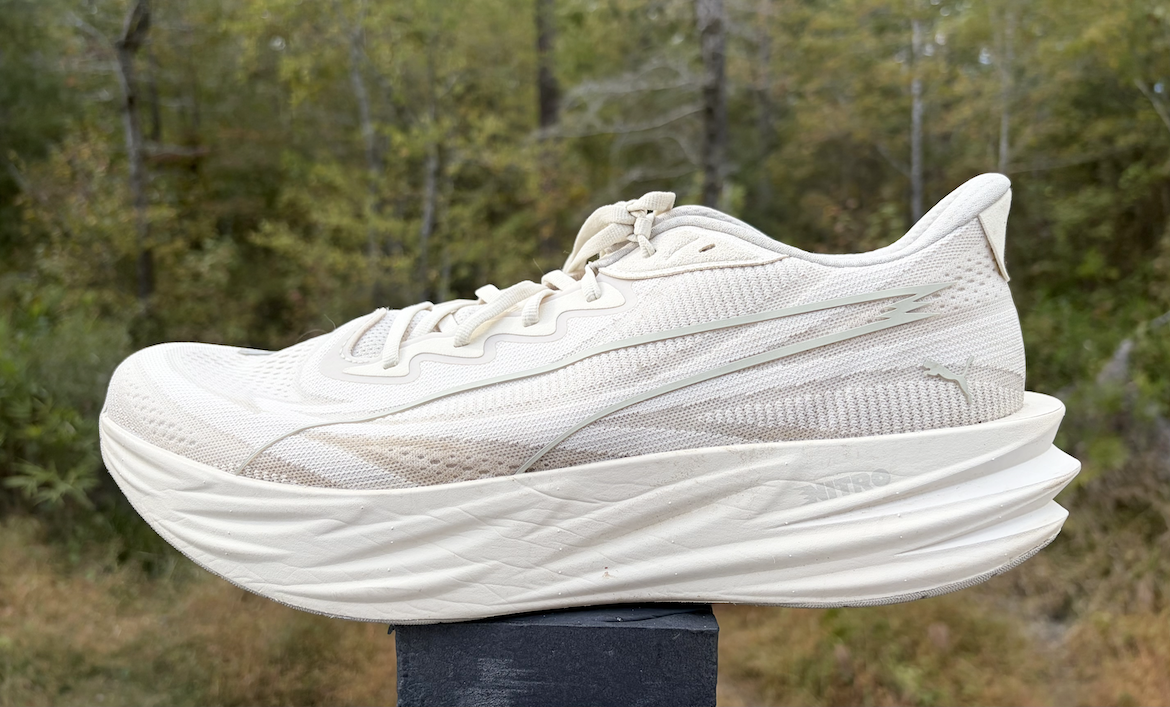
Puma is a brand I’ve had on my radar for years but never tried. They consistently release underrated pairs at attractive prices, a well-rounded lineup of both trainers and racing options, some of which rival models from any running brand. How did my first experience running with the “Big Cat” go? I put the $150 Puma Deviate Pure Nitro to the test, in this review.
Puma Deviate Pure Nitro
Intro
The first thing you’ll notice upon lacing up the Pure Nitro is the weight. It’s almost impossible to miss, because at an impressive 7.5 oz (213 g) for a men’s size 9 and 6.6 oz (187 g) for a women’s size 8, it’s not much heavier than the average super shoe. Of course, the ride of the Pure Nitro doesn’t resemble that of a carbon-plated racer. They’re two very different shoes at two very different prices. The Pure Nitro doesn’t have a plate and is at least $100 cheaper than $250+ super shoes. But it’s also no slouch. Puma positions the Deviate Pure Nitro as a trainer for “up-tempo” runs.
Ride
In the midsole is Puma’s NITROFOAM™, “supercritical nitrogen-infused 100% PEBA.” The foam is lightweight and strikes a good balance between soft and firm, leaning a bit more towards firm. While it is a responsive midsole, you won’t feel much bounce underfoot.
The ride reminds me of the Brooks Ghost Amp, another $150 trainer with PEBA. Naturally, PEBA provides better energy return than EVA foam and the shoe’s featherlight weight makes for a very nimble, agile ride, even with a max stack height of 38/30 mm, again very similar to the 36/30 mm stack of the Ghost Amp.
The 8 mm drop along with the heel bevel design serves heel strikers quite well, yet I do miss the more aggressive rocker geometry found in similar shoes that gives a more propulsive feel. There are some pairs where you can easily set a pace and run without much thought, thanks to the quicker turnover from the rocker design. The Pure Nitro isn’t one of those shoes for me, but that doesn’t mean it doesn’t perform well.
On the plus side, the slight forefoot rocker geometry makes the ride noticeably more stable than other trainers in its category. But again, I’d argue that hurts the shoe’s performance a bit.
Just like christening a brand-new mattress with some humping, the Pure Nitro is a shoe that requires some outsole thumping. My first few runs felt rather firm and dull. It was only after 20 miles or so that the midsole softened up a bit and I started to feel some energy return.
Uses
The pair can handle a variety of different paces with ease: I used it for everything from easy runs to strides and hill sprints and a 10-miler around 8:00/mile pace. Although it can easily tackle long runs, it wouldn’t be among my first choices for runs of 2+ hours. There are more energetic, softer pairs that I favor, like the Topo Specter 3.
The Pure Nitro exceeded my expectations on a workout consisting of 8 miles with 12 x 100 meter strides and 6 x 10-second hill sprints. I was easily running faster than 5k pace (5:30/mile). Of course, I’d want a plated shoe with a super foam to run that fast for longer speed efforts. But regardless, this shoe really has some pop. I have no doubt it can handle longer tempo runs, around 6:30/mile for me, but I just prefer to take the easy way out by wearing a plated shoe.
Again, not to beat a dead midsole, but I think this shoe would be even better with more aggressive rocker geometry. But as is, it’s a very versatile pair that will work well for a variety of runners.
Upper and Outsole
The Pure Nitro’s upper is a bit snug and has a low volume toe box. The fit also runs a bit on the narrow side, so wide-footed runners may want to pass on this one. The upper’s engineered mesh material is breathable and lightweight and a padded tongue and plush heel collar help with a secure foot lockdown. Overall, despite the snug fit, I found the upper to be quite comfy, and was impressed that a shoe this light can have this plush of an upper.
There’s a sufficient amount of rubber coverage on the PUMAGRIP outsole which should provide solid durability even with some minor exposed foam. Puma says you can expect the shoe to last for 500 miles/800 kilometers. I had no issues with traction in wet conditions.
Price
A max cushioned shoe with a PEBA midsole at just $150 is a bargain. It’s the same price as the PEBA-infused Brooks Ghost Amp, although the Ghost Amp weighs a noticeable 1.5 ounces more—another reason to value the Pure Nitro at this price point.
Plus, most performance trainers range anywhere from $160-$200, with the higher end typically including a plate. Of course, don’t expect the Pure Nitro to perform like shoes at the higher end of that range. It’s an above average shoe at $150, but priced higher and there are more attractive options available.
The Pure Nitro is much more versatile and responsive (and lighter) than Puma’s $140 Velocity NITRO™ 5 daily trainer. It’s definitely worth the extra $10 for the better pair.
Conclusion
The featherlight Deviate Pure Nitro is a versatile trainer that offers a lively ride for a variety of runs at a bargain price. Of course, at just $150, you may have to temper your expectations a bit when comparing to other, much pricier performance trainers.
Puma graciously provided this shoe to me for wear testing. I was not compensated for this Puma Deviate Pure Nitro review and Puma didn’t get an opportunity to see this review before I published.