
| PROS | CONS |
|---|---|
| + Bouncy and responsive + An ounce lighter + Redesigned upper + Increased stack height | – Narrower fit |
After a largely underwhelming fifth version, the carbon-plated super-trainer returns with a lighter weight, increased stack height, and updated midsole. Do these updates translate to a ride that better resembles a racing shoe? I detail my experience through 50 miles, in this Nike Zoom Fly 6 review.
Intro
You know who loves the Zoom Fly? I’m talking head over heels infatuated. The men’s GOAT marathoner, Eliud Kipchoge. Sure, he’s a Nike athlete, so he kind of has to like it. But if he didn’t care for the shoe, would he go so far as to say: “This is the shoe runners should choose for their workouts all week long, instead of the super shoes.”
Sure, it could just be a marketing tactic by Nike. But that wouldn’t make sense. The rules of capitalism demand they get customers to spend more money on the $260 Vaporfly and $295 Alphafly super shoes. Frankly, I’m surprised Nike even features that quote on the Zoom Fly webpage.
It’s high praise, for sure. But I sure hope he doesn’t mean every workout. I’m sorry, but no one needs to run with a carbon plate on recovery day. And running in a carbon plated shoe every day is probably not the smartest thing for the average runner. There’s not enough research yet on potential harm caused by overusing them. And if it’s ok with Mr. Kipchoge, I’ll stick with the super shoes. (You win, Nike.) Because I can’t possibly be expected to do a speed workout without a true racing shoe. Could you imagine how much harder that’d be? Yeah, I need all the help I can get. Plus, with increased energy return, carbon plates aid in recovery, resulting in less muscle fatigue.
While the Zoom Fly does have a carbon plate and is positioned as both a race training and racing shoe, it’s not as light and propulsive as Nike’s true racing super shoes.
Nike Zoom Fly 6 Review
| STACK | WEIGHT | PRICE |
|---|---|---|
| 42/34 mm (8 mm drop) | M10: 9.3 oz/265 g W8: 7.7 oz/214 g | $180 |
Midsole
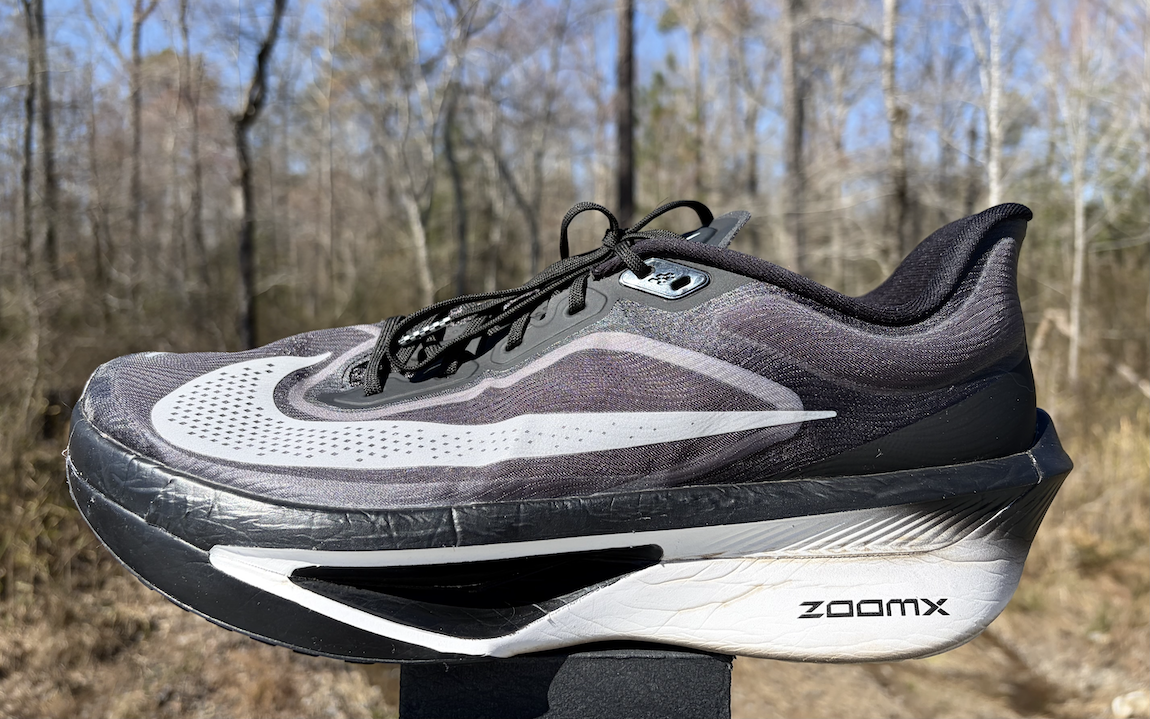
In the top layer of foam, the ZoomX midsole remains, offering Nike’s most lightweight and resilient foam compound. Although there are different variants of ZoomX, the Peba-based foam remains Nike’s most responsive, energetic midsole and is also found in its premium racing shoes and the Vomero line, among others. There’s a firmer EVA-based SR-02 foam base that adds some stability to the ride and enhances the shoe’s durability. Sandwiched between the foams is a full-length carbon fiber Flyplate. It’s unclear if this is the same exact Flyplate found in the Vaporfly and Alphafly. I would think not, given the substantial price difference between the pairs.
The stack height increased about 3 mm in both the heel and forefoot from v5, now sitting mighty tall at 42/34 mm, with an 8 mm heel-toe drop. With this addition in stack, the Zoom Fly is now Nike’s highest stacked carbon plated pair, edging out the Alphafly (40/32 mm) and Vaporfly (35/29 mm.) Of course, it’s not Nike’s tallest shoe. That honor goes to the gigantic Vomero Premium (55.5 mm/45.5 mm).
Ride
Because I’m as soft as Charmin, I rely on super shoes for speed workouts during marathon training. However, the Zoom Fly is one of the few super trainers that can still get the job done — you just have to work a little harder. But comparing any shoe to a carbon-plated racer is like comparing a Sumo orange to a Naval one. Wait, that’s a bad example. It’s like comparing apples to oranges; there we go.
This is a shoe that can truly do it all: daily trainer, speedy pair, and a solid “budget” racing option (relatively speaking) for the runners who don’t want to splurge on higher priced super shoes.
The Zoom Fly excelled in my runs up to 15 miles including for some speedy miles (marathon pace of around 6:50/mile. And although I’d reach for the Vaporfly before the Zoom Fly for a lactate threshold workout, I’d feel confident enough knowing the Zoom Fly could still tackle some speed workouts.
It’s a versatile, light enough pair that can tackle a variety of runs and paces without sacrificing stability. Despite its tall stack height, the Zoom Fly offers a more stable ride than that of the Alphafly and Vaporfly, and is more suitable for a greater variety of runners and strides. It’s also got a noticeably more firm underfoot feel than both of the super shoes, yet still soft enough to the point where I wouldn’t consider it a “firm” shoe.
Of course, the Zoom Fly 6 shines brightest at faster paces thanks to its rocker geometry, ZoomX midsole, and carbon plate. That’s when you’ll feel the bounciness and responsiveness you expect from a Nike running shoe ending in “fly.” The 8 mm heel-toe drop suits heel strikers especially well as there’s a very smooth heel-toe transition aided by the rocker.
Overall, the lighter weight in v6, redesigned shoe geometry, and better upper translate to a more efficient, faster ride.
Upper
There’s a two-layer woven mesh upper that’s much more substantial (and heavier) than the Vaporfly and Alphafly’s minimal nature. Inside, there’s a new, extremely soft sock-like sleeve for enhanced support. It’s a noticeably narrower toebox than previous editions, so those with wide feet may not appreciate the update.
A generous heel collar and semi-gusseted, lightly padded tongue help reinforce my feet for a secure lockdown. Overall, it’s quite the comfortable and supportive upper that still offers solid breathability.
Outsole
On the bottom is a redesigned layer of rubber that offers good traction. Nike added some rubber from the previous edition for more coverage in the forefoot and greater durability overall, especially compared to super shoes’ minimal amount of rubber. There’s a new cutout that shows the Flyplate and improves flexibility.
Weight
One of the biggest knocks on v5 was its substantial weight for what’s supposed to be a speedy pair. Nike heard you loud and clear, and cut around an ounce in v6 (now 10% lighter), for a much more respectable 9.3 oz (265 g) for men’s size 10 and 7.7 oz (214 g) for women’s size 8.
For comparison, the Vaporfly 4 weighs about 2.5 ounces less and the Alphafly is 1.5 ounces lighter. Ouch.
Price
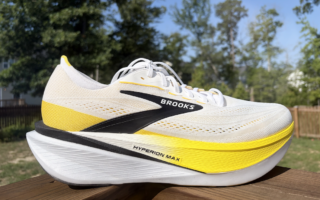
At $180, the price increased $10 from the previous version. Yes, $180 isn’t nothing. But with a carbon fiber plate and additional ZoomX foam, it’s not egregious — especially considering there are many daily trainers without a plate that go for $170. And it’s right in line with plated trainers from other brands, like the $180 ASICS Sonicblast (Pebax plate) and $175 Saucony Endorphin Speed 5 (nylon plate). And it’s $20 cheaper than the nylon-plated Brooks Hyperion Max 3.
Within Nike, the Zoom Fly is $80 dollars cheaper than the $260 Vaporfly and $115 less than the $295 Alphafly.
Aesthetics
Can we be honest? The fifth edition of this shoe was ugly. It didn’t look like a Nike shoe. Fortunately, the 6th edition shoe is sleeker and less bulky. The overall design resembles more of a racing shoe than the boat-looking Zoom Fly 5, thanks to a refined upper and narrower toe box. What’s more, there’s a nice mix of fun colorways to choose from among the seven available, my Black/Light Smoke Grey/White colorway pictured in this review notwithstanding.
Conclusion
An exceptional speedy trainer, solid “budget” racing option for some, and hybrid trainer-racer for others, the Zoom Fly 6 is a vast improvement over its predecessor, with more foam, a lighter weight, and new design.
While naturally not on the top level of the pricier Alphafly and Vaporfly super shoes, it’s a more versatile and stable option for a greater variety of runners.
The Zoom Fly 6 is available on Nike’s website.
Nike graciously provided this shoe to me for wear testing. I was not compensated for this Nike Zoom Fly 6 review and they didn’t get an opportunity to see this Nike Zoom Fly 6 review before I published.
This post includes affiliate links, which means I may earn a small commission if you purchase using the links (at no extra cost to you.)